

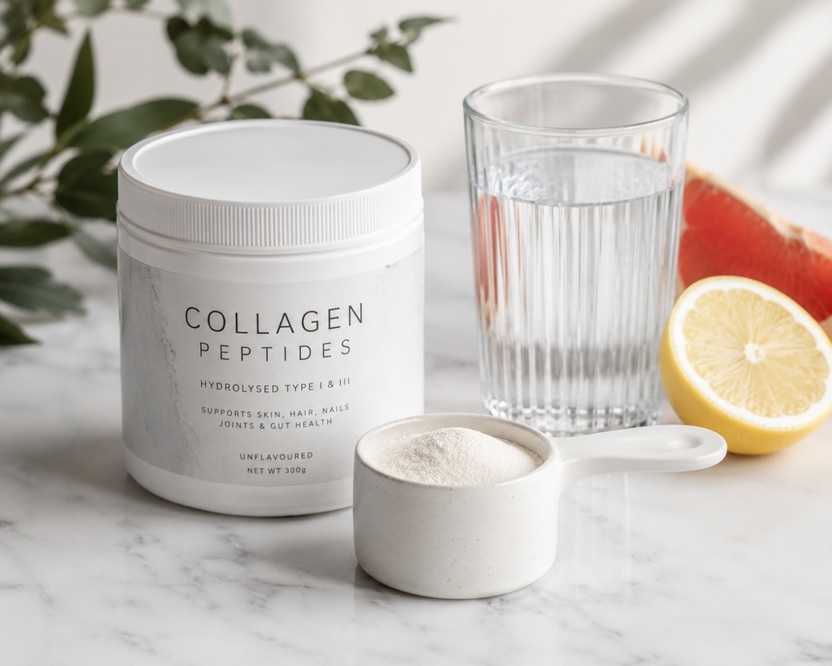
Collagen is the most abundant protein in the human body. It forms the structural scaffold for skin, tendons, ligaments, cartilage, and bone. It’s what gives skin its elasticity and joint cartilage its cushioning. And it declines — steadily and inevitably — from your late twenties onwards.
That biological reality has fuelled a global collagen supplement market projected to reach tens of billions of dollars in the coming years. In Australia alone, the demand for collagen peptides has grown significantly as people look for evidence-based ways to support skin health, joint function, and connective tissue integrity as they age.
But not all collagen supplements are the same. The source, processing method, and purity of a product determine whether you’re getting genuine bioavailable collagen peptides or an inferior product that won’t deliver meaningful results. This guide covers the essentials.
What Is Collagen and Why Does It Matter?
Collagen is a family of structural proteins — there are at least 28 types identified in human tissue, though types I, II, and III account for the vast majority. Type I collagen is the most abundant, found primarily in skin, tendons, ligaments, and bone. Type II is predominant in cartilage. Type III is found alongside type I in skin and blood vessels and is particularly important for tissue elasticity.
The body produces collagen through a complex biosynthesis process that requires specific amino acids — particularly glycine, proline, and hydroxyproline — as well as vitamin C, zinc, and copper as co-factors. As we age, this production slows. Sun exposure, smoking, poor diet, and chronic stress all accelerate the decline further.
The result is visible in skin (loss of elasticity, increased wrinkling), felt in joints (reduced cushioning, increased stiffness), and present in connective tissues throughout the body. Supplementing with hydrolysed collagen provides the amino acid building blocks — and emerging clinical evidence suggests it may do considerably more than just that.
Hydrolysed Collagen: Why Bioavailability Is Everything
Here’s the problem with eating whole collagen protein: digestion breaks it down into individual amino acids, which the body then redistributes according to its own priorities. There’s no guarantee those amino acids end up in skin or joint tissue.
Hydrolysis changes this. Hydrolysed collagen powder (also called collagen peptides or collagen hydrolysate) is pre-digested — broken into short peptide chains of 2–10 amino acids — using enzymatic processes. These peptides are small enough to be absorbed intact through the intestinal wall, enter circulation, and reach target tissues directly.
Research published in journals including the Journal of Cosmetic Dermatology and Nutrients has demonstrated that hydrolysed collagen peptides can accumulate in skin and cartilage tissue after oral ingestion, and stimulate resident cells (fibroblasts in skin, chondrocytes in cartilage) to increase their own collagen synthesis. This is a key distinction — the peptides don’t just replace lost collagen, they signal the body to make more.
Grass Fed Collagen Powder: Why Source Matters
The source of collagen matters for both nutritional quality and ethical reasons. Grass fed collagen powder derived from pasture-raised cattle is generally considered the premium standard. Grass-fed animals have different fatty acid profiles and are typically raised without the routine use of antibiotics and hormones common in intensive feedlot systems. The collagen extracted from their hides and connective tissue reflects that quality.
Conventional collagen products may be sourced from grain-fed, feedlot cattle or from low-grade by-products. The amino acid profile of the collagen itself doesn’t differ dramatically between sources — collagen is collagen — but the broader question of contaminants, processing standards, and ethical sourcing is legitimate.
For Australians, grass-fed bovine collagen is particularly accessible given the country’s extensive pastoral farming industry. Products sourced from Australian or New Zealand grass-fed cattle carry an inherent quality signal, particularly when the processing is clean and additive-free.
Beef Collagen vs Marine Collagen: What’s the Difference?
The two most common collagen supplement sources are bovine (cattle) and marine (fish). Both provide hydrolysed collagen peptides, but they differ in collagen type profile and peptide size.
Bovine collagen — including both beef collagen powder and bovine hide-derived products — predominantly provides types I and III collagen, making it well-suited for skin, joint, tendon, and bone support. The peptides are slightly larger than marine-derived peptides.
Marine collagen is predominantly type I and is derived from fish skin, scales, or bones. Its peptides are generally smaller (lower molecular weight), which may confer marginally superior absorption rates — though the clinical significance of this difference is debated in the literature.
For practical purposes, both are effective sources of collagen peptides when properly hydrolysed. The choice often comes down to dietary preference (pescatarian vs omnivore), ethical considerations, and specific product purity.
What to Look For in a Quality Collagen Supplement
When evaluating a hydrolysed bovine collagen peptides product, several quality markers matter: single-ingredient purity (no fillers, flavours, or unnecessary additives), clear sourcing information (grass-fed, pasture-raised), verified hydrolysis (peptide chains, not whole protein), third-party testing, and a neutral flavour profile that can be mixed into any food or beverage without affecting taste.
Molecular weight is sometimes listed on premium products — typically measured in Daltons (Da). Collagen peptides in the range of 1,000–5,000 Da are considered well-absorbed. Products listing a molecular weight in this range are demonstrating confidence in their processing quality.
The amino acid profile should confirm high glycine (typically 25–30% of total amino acids), proline, and hydroxyproline — the signature amino acids of collagen. If a product doesn’t list an amino acid breakdown, ask why.
Collagen Peptides and Skin Health: What the Research Shows
Skin is where most people first notice the effects of collagen supplementation. Multiple randomised controlled trials — including a 2014 study in Skin Pharmacology and Physiology (n=69) and a 2019 systematic review covering 11 studies — have found that oral collagen peptide supplementation can increase skin hydration, improve elasticity, and reduce wrinkle depth compared to placebo.
The mechanisms proposed include direct incorporation of peptides into dermal tissue, stimulation of fibroblast activity, and upregulation of hyaluronic acid synthesis. Results typically become apparent after 8–12 weeks of consistent supplementation, at doses of 2.5–10g per day.
It’s worth noting that vitamin C is a required co-factor for collagen synthesis — it’s involved in the hydroxylation of proline and lysine, essential steps in collagen maturation. Pairing a collagen supplement with adequate dietary vitamin C or a vitamin C supplement is a logical step for anyone focused on skin outcomes.
Collagen for Joint Health and Athletic Recovery
Beyond skin, the evidence for collagen peptides in joint health is compelling. A 2017 study published in the American Journal of Clinical Nutrition found that collagen peptide supplementation combined with exercise significantly increased cartilage tissue synthesis markers compared to exercise plus placebo. This has practical implications for athletes and active individuals managing joint stress.
For those managing conditions such as osteoarthritis, tendinopathy, or post-surgical connective tissue recovery, a quality collagen supplement may form a useful part of a broader nutritional protocol — though it should complement, not replace, appropriate medical guidance and physical rehabilitation.
The role of collagen in supporting muscle mass is also an emerging area. While collagen protein is not a complete protein (it’s low in tryptophan), studies have shown it can support muscle mass and strength when combined with resistance training — particularly in older adults with sarcopenia.
Conclusion
Collagen is one of the better-supported functional supplement categories, with a growing body of clinical evidence behind specific applications in skin health, joint function, and connective tissue support. The key is quality: hydrolysed peptides from clean, grass-fed sources, without unnecessary additives, at doses supported by the research.
As with all nutrition interventions, collagen supplementation works best as part of a foundation that includes adequate protein intake, micronutrient sufficiency (especially vitamin C and zinc), regular physical activity, and minimising the lifestyle factors that accelerate collagen breakdown in the first place.